Sunday, July 24, 2016

Life Review: Examining Your Life from the Spirit World


Soon after we arrive in the “world beyond” and have recuperated from our time on earth, we begin processing what we experienced the last time around as humans. From what I’ve read and been told by my life-partner, Ron Conroy, who left his earth-body in 2013, this “debriefing” period is known as Life Review. 

Meeting with Guides and Teachers

As I understand it, the soul meets with its guides and teachers to examine its most-recent incarnation, in great depth. These teachers and guides (which some sources call the “Council”) don’t judge, condemn, or punish––they serve as supportive and patient councilors, but they don’t let you avoid things you’d rather not deal with. Some books describe these meetings as taking place in a somewhat formal setting, with “elders” seated at a type of table and the newly arrived soul before them (sort of like a courtroom).


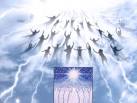
However, that’s not what I saw when Ron showed me his own Life Review group. In trance, I observed several guides seated in a circle with Ron. To me, these masters appeared as purple spirits (see my post “What Color Is Your Soul?” for more information) and they seemed to levitate––probably because without physical substance or gravity, entities sort of float in the spirit realm. In the center of the circle, Ron’s teachers/guides presented scenes from his past life, in a manner similar to a hologram.

Revisiting Your Thoughts, Words, and Deeds

During your Life Review sessions, you revisit what you did, thought, felt, said, etc. in the course of your previous lifetime on earth. Not only to you review what happened from your own vantage point, you also experience your life from the perspectives of all the other people involved. You get to see how your actions affected them. If you harmed someone in your last lifetime, you feel that person’s pain. If you gave someone joy or comfort or love, you sense what he or she felt. “It’s hard, and it takes a long time,” Ron told me, “but it’s interesting.”


Perhaps you’ve heard that when you die your whole life flashes before your eyes, instantly. This is often expressed by people who’ve had near-death experiences. Dr. Piero Calvi-Parisetti’s course Love Knows No Death contains a powerful video module in which a number of people who’ve had NDEs discuss this. However, these people were revived and didn’t stay on the Other Side. What they describe is not the same thing as a life review.

As Ron explained it to me, you review your previous incarnation at your own pace––and it takes as long as it takes. “You can start at the end of your life and work back or start at the beginning and move forward, so long as you cover everything. Life Review is mandatory, but doesn’t have any deadlines.” 

Restoring Balance

One of the hardest parts of Life Review is facing up to the suffering you caused others. However, now that the soul is free of ego, it can examine situations objectively, without emotion. By going through this period of discovery, you learn how you can handle things better in the future, how you can be kinder and more loving. You also find ways to make restitution to those you’ve injured. Depending on the “offense,” you may only need to acknowledge what you did or perhaps apologize. In other instances, you might choose to offer greater recompense.


This is not punishment or payback, an eye-for-an-eye and all that. The purpose, as I understand it, is to restore balance and to give love where you caused pain before. It may also be necessary––for your soul’s growth––to experience both sides of a situation. For example, in one of my previous incarnations the entity I knew as Ron in this life was responsible for my death. In this lifetime together, he gave me the power to end his life by taking him off life-support after he suffered a massive stroke.

What you learn in Life Review will influence future lifetimes. Understanding the big picture enables you to choose lives that will further your soul’s purpose, and gives you the wisdom to do a better job next time around.

Saturday, July 16, 2016

Choosing Your Death


In the New Testament of the Christian Bible, Matthew 24 warns that no one knows the day or hour of his death. However, some spiritual teachers and researchers who study reincarnation tell us that we choose our lifetimes on earth as well as the conditions of our physical existences. We also choose when and how we depart from earth, to return to our true home in the spirit world.


Going Home

Although many of us fear and dread physical death, everything I’ve witnessed and read indicates that we have nothing to worry about. Brian L. Weiss, MD, in his book Many Lives, Many Masters, writes, “To be in physical state is abnormal. When you are in spiritual state, that is natural to you.” People who’ve had near-death experiences generally say life outside the human body is a whole lot better than it is here on earth. Dr. Piero Calvi-Parisetti’s course Love Knows No Death includes a video module of many people who’ve had NDEs; all described similar and wondrous experiences.

If you’re someone who can communicate with spirits in the nonphysical realm, you’ve likely heard them say they’re happy where they are now. In his book Journey of Souls, Michael Newton, PhD, reports that clients he has regressed through their prior deaths usually say something like: “Oh, wonderful, I’m home in this beautiful place again” or “I’m relieved to be away from Earth.” My long-time partner, Ron Conroy, who left his body in 2013, tells me often how much happier and more peaceful he is now. “What we call the ‘other world’ is the real one,” he explains, “earth is an illusion.”


Leaving Our Lives

Some might interpret this as a reason for suicide, even though some religions insist that suicide is a sin. As I understand it, however, our teachers, guides, and spirits don’t judge or punish us––they welcome everyone, including suicides, back home. But people who decide to end their physical lives early will still have to complete the lessons they skipped out on, during another earthly incarnation.

After his physical death, Ron told me that even if we go quickly (as he did, from a stroke) we’ve actually made the decision much earlier. “We leave in stages, gradually detaching from the physical world,” he explained. Nine months before he passed, he told a mutual friend of ours that he wanted to die of a stroke before his seventieth birthday––which is exactly what happened. He picked the moment and method for his departure, not through suicide, but through intention.

Why, then, would anyone choose a painful or gruesome death? When I asked Ron this question, he replied that some souls accept terminal illnesses, such as cancer, to give doctors a chance to study the disease and learn ways to help other people. In some instances, souls decide that their host bodies will die in traumatic ways in order to raise awareness of a situation or to inspire interest in a particular cause. This may be true of warrior souls who die in battle. Undoubtedly, numerous other reasons exist, perhaps as many as the individuals involved.

If it’s any comfort, Dr. Newton writes in Destiny of Souls that “souls often leave their bodies seconds before a violent death.” And if we really do reincarnate on earth many, many times, then we’ve all gone through numerous deaths––and survived.


Saturday, July 9, 2016

Spirit Guides and Angels


In my book Angels Among Us, I mention a poll done by the Washington Post in 2008, in which 36,000 people of various faiths (or none) were asked if they believed angels actively participate in our lives. The majority answered yes. That same year, in a poll by Baylor University Institute for Studies of Religion of 1,700 Americans, 55 percent reported that their angels had protected them from harm.


What Are Angels?

Many people think that when we die we become angels. But according to Billy Graham’s website that’s incorrect––we become something greater. The Compelling Truth’s website says, “Humans are physical beings with a spiritual soul” whereas “Angels are spiritual beings . . . who can only become physical if God ordains that their work requires it.” Others say angels don't have free will, as humans do, and therefore humans face greater challenges during their journey on earth and in the spirit realm. Much has been written about angels throughout history, and these ethereal beings show up in the literature of many religions. Yet we’re still not certain what they are, how they came to be, or exactly what our relationship with them is.

The Christian mystic Dionysius the Areopagite, 1500 years ago, and later the Dominican priest and philosopher St. Thomas Aquinas proposed that nine types of angels exist. These ranged from the lowest level––our personal guardian angels––to the highest––the Seraphim, who occupy the top rung of the celestial ladder, closest to God, where their singing aids the process of creation.


 Our Progress as Spiritual Beings

As I understand it, we may evolve into spirit guides at some time after leaving physical earth. During my visits to the spirit realm, I observed souls as colored orbs of brilliant light. Their colors indicated their level of wisdom and experience (see my post “What Color Is Your Soul?” for more). Blue and purple souls were the masters, who guided beings on earth. These masters once existed as humans, but have now reached an advanced level and no longer need incarnate––though they may, if they choose. Other souls––especially those from our own soul groups––may also assist us throughout our earthly lives. (See my post “Soul Groups” for more.) I suspect that these entities are the ones who watch out for us, though I don’t know if they’re actually angels.

After my long-time companion, Ron Conroy, left his physical form in 2013, I asked him about this conundrum. He replied, “When people ‘die’ they don’t become gods or angels, they’re still themselves, they’re just not physical.” He also explained that our core natures remain the same after we leave our bodies––we’re still playful, quiet, serious, adventurous, artistic, etc. Our fundamental purposes and interests stay with us too. (See my post “What’s Your Life Purpose?” for more.) Our egos fall away, however, leaving us “kinder and gentler” than we were as humans.


Meeting Angels and Other Spirits

Psychic and medium Francine Clausen, “The Angel Lady” of Gloucester, Massachusetts, told me each of us has at least seven angels around us all the time––and we can call upon more for assistance when we need them. I think it’s possible that both spirit guides and guardian angels offer us protection and aid. Furthermore, I think it’s likely that we knew some of these spirits on earth––as I knew Ron for many years––but we may never have encountered some of them in physical life. (Nature spirits, fairies, and other ethereal entities also exist among us, but that’s a topic for another post. You can also read more in my book Fairies: The Myths, Legends, and Lore.)

In his book Journey of Souls, Michael Newton, PhD writes, “Most of my subjects report the first person they see in the spirit world is their personal guide.” Even if other entities that the newly deceased person knew on earth are present, the individual’s main spirit guide stands nearby, ready to escort the soul into the spirit realm. This guide, it seems, remains with us throughout all our earthly incarnations as well as during our time out of the body––teaching, protecting, and steering us through life with great love and compassion.


Children often speak of seeing their spirit guides, although adults usually discount these claims, labeling the spirits “imaginary friends” or “alter egos.” You may meet your spirit guides through meditation, trance states, dreams, hypnosis, moments of illness or trauma––they may even appear to you during your everyday, waking life. People sometimes describe them as light forms in the shape of a human being, as angels with wings, or as faint ghostly images. Others see them as glowing orbs, as I did in my journeys to the spirit realm. 

Even if you don’t actually see them, you may sense their presence, perhaps as warmth or coolness, a slight breeze or movement, a tingling sensation on your skin, or something else entirely. Once, while I was giving Reiki to a woman, I felt her guide standing behind me, laying its hands over mine to provide healing energy through me to the woman.

Trust your experiences, whether you see, hear, sense, smell, or otherwise become aware of your spirit’s presence. If you keep an open your mind, you have a good chance of making contact with your spirit guide and benefiting from what it has to share with you.

Saturday, July 2, 2016

Why Did You Choose This Life?


Past-life researchers and people who believe in reincarnation propose that we choose our lifetimes on earth for specific purposes. We select our parents and families, the physical bodies we’ll inhabit, the cultures in which we will live, the timeframe during which we’ll exist, and the challenges we’ll face. Astrologers say that we also look at celestial configurations to determine what combination of energies will offer us the best potential for achieving our goals. I’ve read that although the individual soul gets to make the final decision, our guides and teachers offer suggestions and assist us in making these important choices.


Why Pick a Hard Life?

If that’s so, you may ask, why would anyone choose a lifetime of hardship, pain, illness, poverty, or suffering? The usual answer is: to learn, and some things must be learned the hard way. Another theory states that we take on onerous conditions in a particular incarnation in order to atone for past misdeeds. In his book Miracles Happen, Brian Weiss, MD writes that a soul may enter a body that has more than the usual limitations in order to learn to receive from others, to be cared for––especially if that soul has served as a caregiver in many lifetimes. 

It seems to me that as evolving souls who will eventually become spirit guides ourselves, overseeing the human race, we may need to experience everything that morals undergo, so we can understand and assist them in their earthly journey. If you’ve never suffered the loss of a loved one, for instance, you might not know how to ease another’s grief.

Reasons for Incarnating

In my earlier posts, I’ve suggested that we incarnate for other reasons too: to be with members of our soul group who’ve already entered human forms; to work on relationships that we began in previous lifetimes; to create in the manifest world; to inspire or implement changes on Planet Earth. Most importantly, we come here to bring love from our divine “home” into the physical realm.

As I wrote in my previous post “What’s Your Life Purpose?” your lifetimes are based on certain themes. Soul roles fall into various categories, such as teacher, healer, warrior, leader, etc. Therefore, you’ll integrate your soul’s primary purpose into each incarnation, even though the details will differ. If you’re a warrior soul, for example, you might have been a gladiator in Ancient Rome, a soldier during the French Revolution, and a football player today.

My post “What Color Is Your Soul” discusses soul colors as indicators of spiritual knowledge and development. During visits to the spirit world, I saw multitudes of white souls (beginners), but very few purple ones (masters). This idea is reiterated in the books of Michael Newton, PhD, Journey of Souls and Destiny of Souls. As my partner, Ron Conroy, who left the physical world in 2013, explained it to me, the younger white souls often enter lifetimes where they can learn basic survival skills and practice adapting to the requirements of earthly embodiment. These souls may not have spent much time on this planet and must develop their “earth legs” before they can help others. People who live relatively primitive or very simple existences, in which they have few responsibilities other than sustaining themselves, may fall into this group.


Souls who’ve graduated to higher levels (yellow, gold, green), perhaps through many lifetimes on earth, face a different set of challenges and opportunities. They may choose incarnations in which they must consider and/or take care of others as well as themselves. Perhaps they’ll share what they’ve learned with other beings. Or, they may assume responsibility for other humans, animals, plants, etc., protecting or guiding these entities in their own growth. More developed souls may bring knowledge to earth’s inhabitants, provide support or employment to others, create products that make physical existence easier, defend communities in times of crisis, etc.


Eventually, we accomplish our earth “lessons” and reach a high enough level of spiritual development where we no longer need to incarnate. As blue or purple souls, we may choose to operate from a nonphysical realm instead of taking on human bodies. I suspect levels far beyond this exist, but I can’t speak to that––yet.


Saturday, June 25, 2016

What Color Is Your Soul?


In 2004, during meditation, I began seeing colors associated with people I knew. I understood these to be their “soul colors,” not their auras. Auras envelop the body like a halo or cocoon of light, and their colors are influenced by conditions in our physical bodies and our emotions. As our bodies or feelings change, so do our auras in response. The soul colors I saw, however, had nothing to do with my friends’ physical selves, and I didn’t see the colors while in my ordinary beta state. Rather, the colors expressed these individuals’ core beings, the light-energy of their spirits or souls. I’d never heard of such things before, but I didn’t doubt what I’d experienced––I simply accepted it, though for some reason I didn’t investigate further at the time.


Glowing Orbs of Light

The core energies I witnessed looked like glowing orbs of light, some translucent, some denser. Some of the orbs were solid colors, others blends of two or more hues. I observed yellow, gold, green, and one pale blue soul within my circle of close companions––and a watery-blackish one that represented the spirit of someone I had not known in this lifetime and who does not currently reside on earth. I sensed my own soul image as well, a soft yellow-gold, and did a painting of my soul-self.

In addition to seeing colors, I sensed energetic qualities emanating from the orbs. Some felt powerful, others gentle; one seemed restless, another centered and calm. I could watch them move too. The blue orb zipped about, propelled by an extension rather like a pseudopodium. The green one’s motions were slower and steadier. The blackish soul washed over me with a frightening force that reminded me of a tidal wave.

After my beloved life partner, Ron Conroy, left his physical body in 2013, he began guiding me on sojourns to the spirit world. On my first journey to the “home” where now lives––the place where we all go when we leave our human bodies––I saw shining orbs of light just like those I’d witnessed in my earlier mediations! Souls! Multitudes of them. So many, all pulsing and undulating, that they looked like an endless sea of sparkling soap bubbles. Most were white, but I also saw reddish, yellow, gold, green, blue, and a few purple ones among them. In my earlier meditations, I’d observed Ron’s soul as a deep, rich, solid gold; now I noticed tiny flecks of green in it as well. Surrounding everything, like a giant net that held all the souls together, I saw a beautiful pinkish light––the energy of love.


Levels of Development

Some months later, I read Journey of Souls by Michael Newton, PhD. To my surprise, he wrote that souls appear as colors, and that these colors distinguish their levels of development. The many people he’d hypnotized described seeing the same thing I’d seen! For the first time, I’d found some validation or at least collaboration for what I’d experienced. According to Dr. Newton’s subjects, white souls are “beginners” (Ron called them “baby souls just learning to crawl”). They constitute the vast majority of entities in the spirit world and on earth. Yellow souls are intermediate beings (Ron likened them to “teenagers”), gold ones high-intermediates, light blue advanced souls, and indigo/purple are highly advanced masters. And as I’d witnessed, the hypnotized subjects explained that the more advanced souls projected stronger power and could move more rapidly. But Dr. Newton didn’t mention green or black souls, yet I’d seen both. Not until his book Destiny of Souls came out nine years later did he include those colors in the pantheon of souls.

As we evolve, perhaps over millennia, our soul colors shift to show our levels of knowledge and mastery. Ron described the color identifications as being like karate belts. High-level souls (blue and purple) serve as guides and teachers for the rest of us. What color is your soul? Can you sense or see it? You probably won’t observe it with your physical eyes (the way some sensitive people see auras), and it’s unlikely that Kirlian or aura photography will reveal it. But perhaps through meditation or trance states, shamanic journeying, or a dream you’ll discover your true color.


Saturday, June 18, 2016

Soul Groups


After my long-time partner, Ron Conroy, left his physical form in April 2013, he began communicating with me about the place where he now resides, a place he calls “home,” and showing me what it’s like in the spirit world. What he described, and what I witnessed, closely matched what I later read in books by Michael Newton, PhD. Even the use of Ron's word “home” to describe the spirit realm we return to after physical death is echoed in the accounts of people who’ve undergone near death experiences, shown in a video module of Dr. Piero Calvi-Parisetti’s course Love Knows No Death.

Primary and Secondary Soul Groups

In the realm of spirits, entities cluster together in groups in which some affinity exists––just as people on earth do. Not all souls associate with all others––though they could if they wanted to because ultimately none of us is an island separate from the rest. But souls in the spirit world, as we earthlings do, tend to hang out with beings who have similar interests or purposes.


In his book Destiny of Souls, Dr. Newton writes that “primary groups”––somewhat like families––consist of three to twenty-five souls who have close ties to each other. “Secondary groups” may contain 1,000 souls or more and resemble communities. The souls in these larger clusters may interact for various reasons, such as joining forces to assist in a particular project or to achieve a common goal.

Souls in primary clusters are bonded forever. They work, learn, and play together in the spirit world, and often reincarnate together on earth or in other places. They do this partly because their paths and purposes are aligned, but also because they just want to be together. According to Dr. Newton, soul mates and beings from the same primary soul group don’t usually incarnate as humans within the same biological family, however, which I found interesting.


Ron explained that primary soul groups may be self-contained circles, or they can overlap, like the intersecting rings of the Olympics logo. He said this means that although he and I are in the same primary soul cluster, some beings in other clusters overlap ours. As a result, some souls who are in my primary group aren’t in his, and vice versa.  

As well as sharing related interests and purposes, beings within a primary group usually possess similar levels of knowledge. Beginner souls and master souls don’t cluster together in the same intimate group––although souls with varying degrees of knowledge may interact at times for certain reasons. I also got the impression that as one soul in the group advances, the soul’s increased knowledge and experience aid the advancement of the entire group.

While looking at pictures of crop circles, I noticed a similarity to the soul clusters I’d seen in the spirit world and began to wonder. Are these mysterious designs, which appear without explanation in fields across the earth, actually images created to help us understand something about our existence as spirits?


Meeting Our Soul-Group Mates

Often we recognize people we know now as people we’ve known before. Individuals who undergo past-life regression frequently describe meeting the same souls in lifetime after lifetime. A son in this incarnation may have been a husband or a brother in a previous one. Many writers and researchers in the field of reincarnation have talked about this, and I’ll discuss it more in future posts.

Think about the people you know and have known during this incarnation. These may be friends, relatives, business colleagues, powerful influences in your life, teachers, helpers, or adversaries. Which ones do you consider the most important? What roles have they played for you? Did you feel a powerful connection to these people when you first met, as if you’d known each other forever? Does a person push your buttons? Did you meet under synchronistic circumstances? For example, I met Ron fifteen minutes after saying goodbye to a former boyfriend at the local train station. Driving home, I said “Okay, Goddess, what do you have for me now?” As I pulled into my driveway Ron rode by on his bicycle. He turned around, pedaled up to me, and introduced himself. We were together for the rest of his physical life––and still are.

Are you aware of people in your current life whom you feel you’ve known before? What insights or experiences have led you to think this way? How do you interpret your present-life interactions with these people? Can you see links between “then” and “now”? What are you learning from each other? Are you carrying on work from another lifetime? How can you help one another this time around?

Sunday, June 12, 2016

What’s Your Life Purpose?


No doubt you’ve wondered about your purpose in life: Why are you here? What are you supposed to accomplish during your time on earth? How can you fulfill your mission?

In my first post, “Welcome to My New Blog about the Afterlife,” I wrote that we come to earth to bring love to this troubled planet from our true “home” (the place we go to between physical incarnations). We all have the same, universal goal of dispelling fear and suffering through the power of love. However, our souls may seek embodiment for individual reasons too.


Life on a Hard Planet


Sometimes we take human forms in order to be with people we love who are living on earth. Other times, we may incarnate to rectify or complete a situation rooted in another lifetime. Many spiritual teachers refer to earth as a “school” where we come to learn. In his book Many Lives, Many Masters, Brian L. Weiss, MD, reports that there are “different levels of learning, and we must learn some of them in the flesh. We must feel the pain. When you’re a spirit you feel no pain.” In Conversations with God, however, Neal Donald Walsh proposes that we choose earth lives, not to learn, but “To remember, and re-create, Who You Are.” He writes “life is not a process of discovery, but a process of creation.”

Many sources describe earth as a “hard” planet, a difficult place to live. The dense energy of earth and the limitations of the physical body pose challenges for the incarnating soul. When we enter human forms, we lose some awareness of the immense love and light we knew in the spirit world and become immersed in the fear that prevails on earth. Apparently, this amnesia is necessary, so we can meet the challenges facing us and grow through struggle. No pain, no gain.


Soul Roles


After my beloved life partner, Ron Conroy, left his physical body in 2013, I began studying the spirit realm, life between lives, and reincarnation in depth. I read lots of books, talked to mediums and psychics, did past-life regressions, and visited other worlds through shamanic journeying. During the course of my explorations, I noticed that souls seemed to fall into certain categories, according to their natures, their purposes, and the roles they play on earth (and elsewhere). I identified several classifications or types of souls: leaders, protectors, teachers, healers, warriors, artists, inventors, explorers, and caretakers, though I’m sure I’ve missed some. If you trace your “lineage” through a series of lifetimes, you’ll probably see a thread of continuity running through most of your lives. The details of the lives themselves will be different, but an underlying theme remains consistent.

For example, in one of my lifetimes about 3,000 years ago, I worked as a slave in the library at Alexandria, Egypt, where I was exposed to knowledge and written words. In a later incarnation as a nun in a convent, I served as a scribe copying manuscripts. This time around, I’ve devoted myself to writing and sharing information. It seems that my soul’s role is that of the teacher and that I’m carrying on today with what I began long ago. However, I’ve also had healer lifetimes: as a wise woman/midwife in a small Scottish village about 1,000 years ago and as a nurse’s aide in a veterans’ hospital after WWI. In this incarnation, I practice Reiki and other forms of energetic healing, and often write about holistic healing. As you revisit your own past lives, you may find that you, too, integrate more than one path in fulfilling your destiny.


Your role may not fit under a narrowly defined heading, or your soul may interpret its purpose more broadly than we humans do. Athletes, for instance, are often warrior souls. Environmentalists may be caretakers, protectors, or healer souls who focus on aiding the earth. My former husband is a healer soul, but he doesn’t work as a health professional. Instead he renovates––“heals”––antique houses.

How can you determine your soul’s purpose? Meditation, hypnotherapy, and past-life regression may help you gain insights. A simple way to discover your path is to pay attention to what gives you joy. When are you the happiest? When do you lose track of time and immerse yourself totally in what you’re doing? Follow that thread and you could find it leads to your true purpose, in this life and beyond.